Permanent POP displays in retail stores to increase sales
Custom designed POP displays for home care products
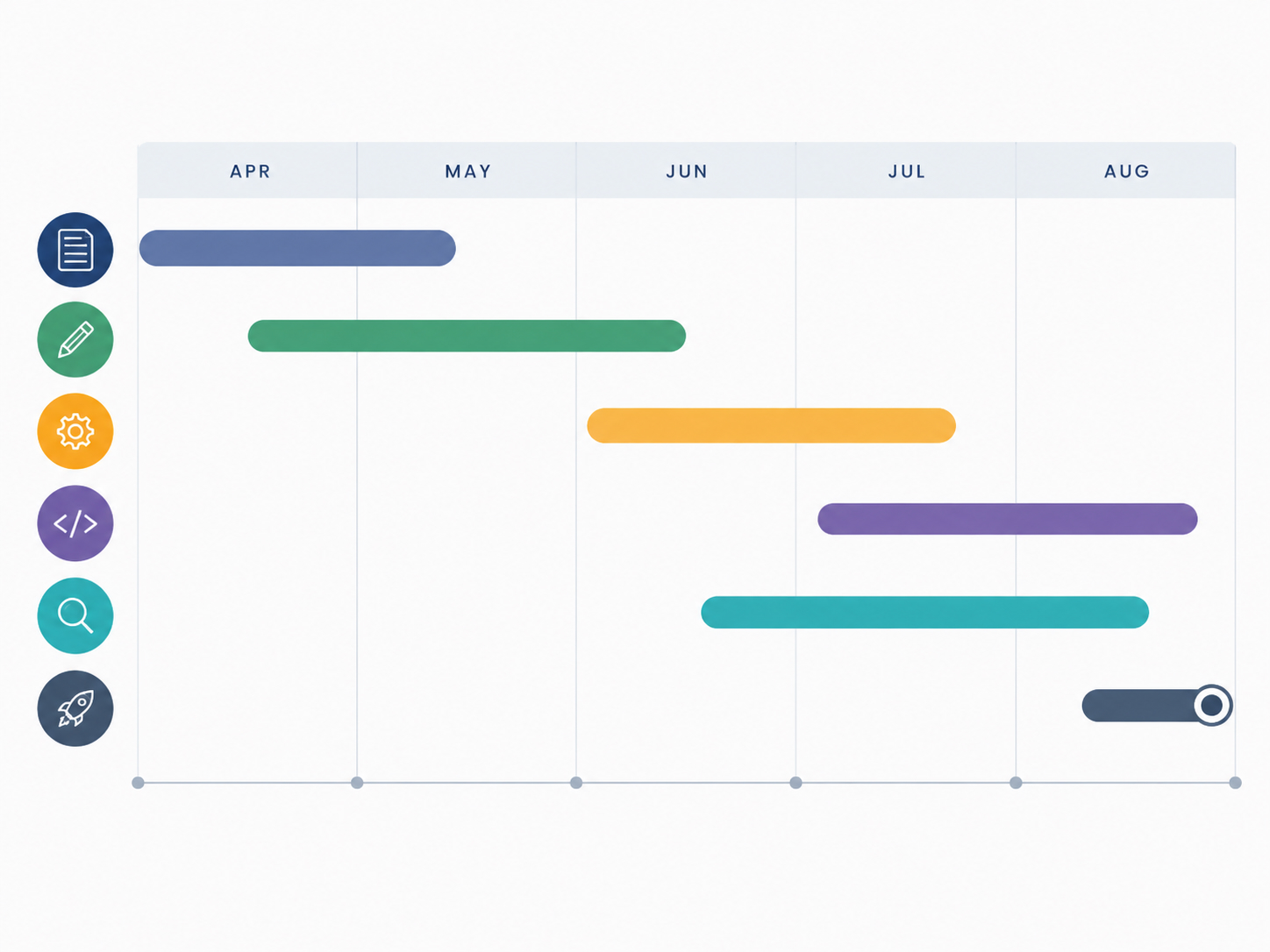
A new custom cardboard display takes 7 to 8 weeks from brief to delivery when manufactured in Australia, or 11 to 12 weeks when manufactured in China. A new permanent display takes 17 to 19 weeks. A re-run of an existing cardboard design takes 4 to 5 weeks from Australia and 8 to 9 weeks from China.
Those figures assume one thing that sits outside our control: that your artwork is supplied & approved on time. Artwork is the single most common cause of a display taking longer to arrive in store or for deadlines to be missed. It is the one stage of the process owned entirely by the client & all the internal stakeholders. Then secondly that physical samples are provided to be able to do necessary weight testing with.
This page breaks each timeline into its individual stages so you can work backwards from your in-store date. It follows the same four phases described in our design process, with the durations outlined.
Timeline 1: New cardboard or temporary display
Most promotional POS falls into this category. Free standing display units, PDQ trays, counter units and shipper displays for a campaign, a product launch or a seasonal range.
| Stage | Duration | Who owns it |
|---|---|---|
| Brief, visuals and quoting | 1 week | Genesis, with your input |
| Design and physical sample | 1 week from receipt of your products and order | Genesis |
| Keylines issued | 2 days from sample approval | Genesis |
| Artwork creation | Variable | You and your retailer |
| Proofs and approvals | 1 to 1.5 weeks from artwork supply | Genesis, with your sign-off |
| Production, Australia | 4 to 5 weeks from proof approval | Genesis |
| Production, China | 8 to 9 weeks from proof approval | Genesis |
Total: 7 to 8 weeks (Australian production) or 11 to 12 weeks (Chinese production), excluding artwork creation time.
Two stages depend on you rather than on us.
- The design and sample stage cannot begin until we have physical product in hand, because the structure is engineered around the actual weight, dimensions and centre of gravity of what it holds.
- The artwork stage runs to whatever schedule your creative team and your approval processes dictate. This can take longer than anticipated if local and overseas marketing teams are involved.
Timeline 2: Re-run of an existing cardboard design
If the keylines and artwork already exist and nothing is changing, the design, sample and proofing stages disappear.
| Production location | Duration from proof approval |
|---|---|
| Australia | 4 to 5 weeks |
| China | 8 to 9 weeks |
This is the argument for designing a display that can be reprinted with new graphics on the same structural footprint. A campaign refresh becomes a four week job rather than an eight week job. It is worth raising at the brief stage if you already know the display will run more than once.
Timeline 3: New permanent display
Permanent and semi-permanent units in timber, sheet metal, acrylic or a combination carry longer timelines because they involve tooling, structural engineering and physical load testing.
| Stage | Duration |
|---|---|
| Brief, visuals and quoting | 2 weeks |
| Prototype and testing | 4 to 5 weeks from receipt of your products |
| Production, China | 11 to 12 weeks from prototype approval |
Total: 17 to 19 weeks, excluding artwork and any retailer approval cycles.
- The prototype stage is where permanent projects earn their timeline back.
- A physical prototype can be placed in an office or in a live retail environment, loaded with real stock, and assessed for stability, capacity, restocking access and assembly time.
- Faults identified at prototype stage cost days. The same faults identified after a tooled production run of several hundred units cost months.
Working backwards from your in-store date
The practical question is rarely “how long does it take”. It is “when do I need to start”. Set your required in-store date, then add distribution time on top of the production figures above.
| In-store date required | New AU cardboard: start by | New China cardboard: start by | New permanent: start by |
|---|---|---|---|
| 1 March | Early January | Early December | Late October (prior year) |
| 1 June | Early April | Early March | Late January |
| 1 October | Early August | Early July | Late May |
Add one to two weeks if units are distributed to individual stores nationally rather than to a single warehouse or field team.
Two seasonal constraints matter for Australian retail planning. Chinese production shuts down for approximately two weeks around Chinese New Year, which falls between late January and mid February depending on the year.
Anything landing in stores for the Christmas trade competes for the same freight and factory capacity from September onward. Both should be treated as fixed obstacles rather than negotiable ones.
What actually causes delays
In our experience the timelines above hold when the project is properly resourced at the client end. Where projects slip, the cause is usually one of five things.
- Artwork arriving late. Keylines are issued two days after sample approval. If artwork returns three weeks later, the entire project has moved three weeks. This is the most frequent single cause of a missed in-store date.
- Product samples not supplied. Design and prototyping both begin from receipt of your physical product. Sending product on day one rather than day ten removes a week and a half from the schedule.
- Retailer approval not sought early enough. Major Australian retailers maintain display guidelines covering footprint, height, materials and safety. Where retailer sign-off is obtained before the brief, the brief and quoting stage can be shortened. Where it is sought after a design has been developed, it can trigger a redesign or delays while you get an exception.
- Changes after proof approval. A structural or graphic change once production has commenced restarts the production clock. It does not pause it.
- Underestimating the approval chain. Count the number of people who must approve the design internally, then add your retailer if required. A five person chain with a two day turnaround each is a fortnight of calendar time that appears nowhere in a production schedule.
When a faster option exists
Not every campaign allows for a seven week lead time. Where the timeline is genuinely immovable, three levers are available.
- Australian production rather than offshore production reduces manufacturing by four weeks. It costs more per unit and is generally suited to lower volumes.
- An existing structural design with new graphics removes the design, sample and keyline stages entirely.
- A pre-engineered display format avoids new structural design altogether. Our Presto instant display range exists for this reason.
Reducing the design or prototyping stages to save time is a false economy. Those stages exist to identify problems before the problems are replicated several hundred times and shipped to stores.
Frequently asked questions
How quickly can I get a quote?
Quoting sits inside the first stage, which runs one week for cardboard displays and two weeks for permanent displays. A brief that includes product dimensions, quantities, retailer, and required in-store date can be quoted faster than one that does not. Our free brief template sets out the information required.
Why does China production take twice as long as Australian production?
The difference is sea freight and factory scheduling rather than manufacturing speed. Chinese production is the more cost effective option at volume, and the additional weeks are predictable and plannable.
Do I need to send you my actual product?
Yes, for any custom structural design. Displays are engineered around real weight, dimensions and packaging. Working from a specification sheet alone introduces risk that is only discovered when the display is loaded in store.
What if my display needs to be in store in four weeks?
A re-run of an existing design produced in Australia can meet that window from proof approval. A new custom design cannot. In that situation the conversation should be about a pre-engineered format rather than a compressed custom build.
Are these timelines guaranteed?
They reflect the schedules we work to across hundreds of completed projects. They assume timely artwork supply, prompt approvals and no scope changes after proof sign-off. A specific project timeline is confirmed at quoting stage.
If you have a fixed in-store date, the most useful thing you can do is establish the start date now rather than the finish date. Contact the Genesis team with your product, quantity, retailer and required in-store date, and we will confirm whether the timeline is achievable and which production path fits.
About the author.
Andrew Mansfield is a point of sale designer at Genesis Retail Displays, an Australian custom POS design agency and manufacturer based in Gregory Hills, NSW. The Genesis team has more than 60 years of combined experience designing and manufacturing retail displays for brands including Lindt, Logitech, Panasonic, 3M and Pfizer, across retailers including Coles, Woolworths, Officeworks, JB Hi-Fi and Harvey Norman.