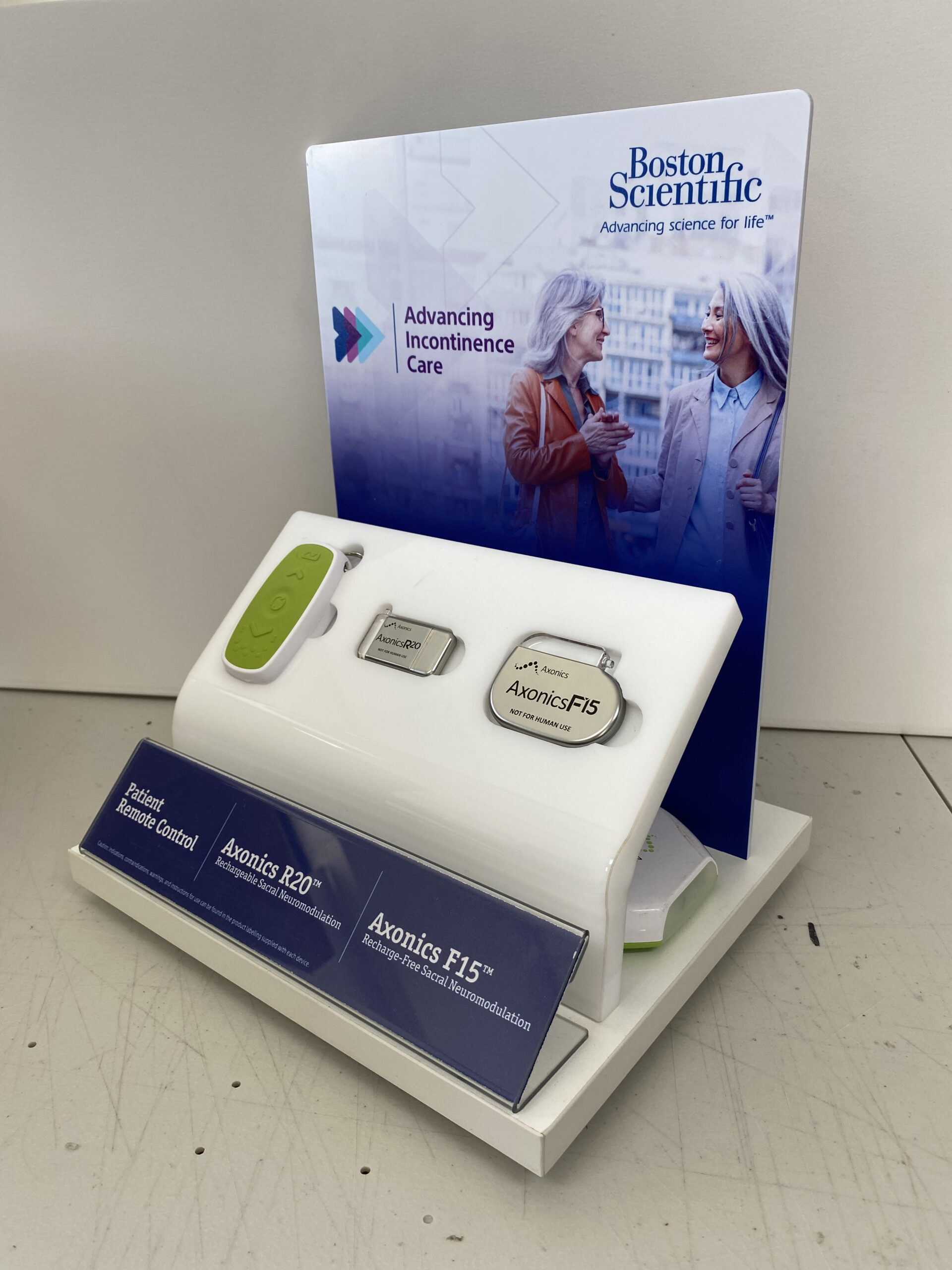
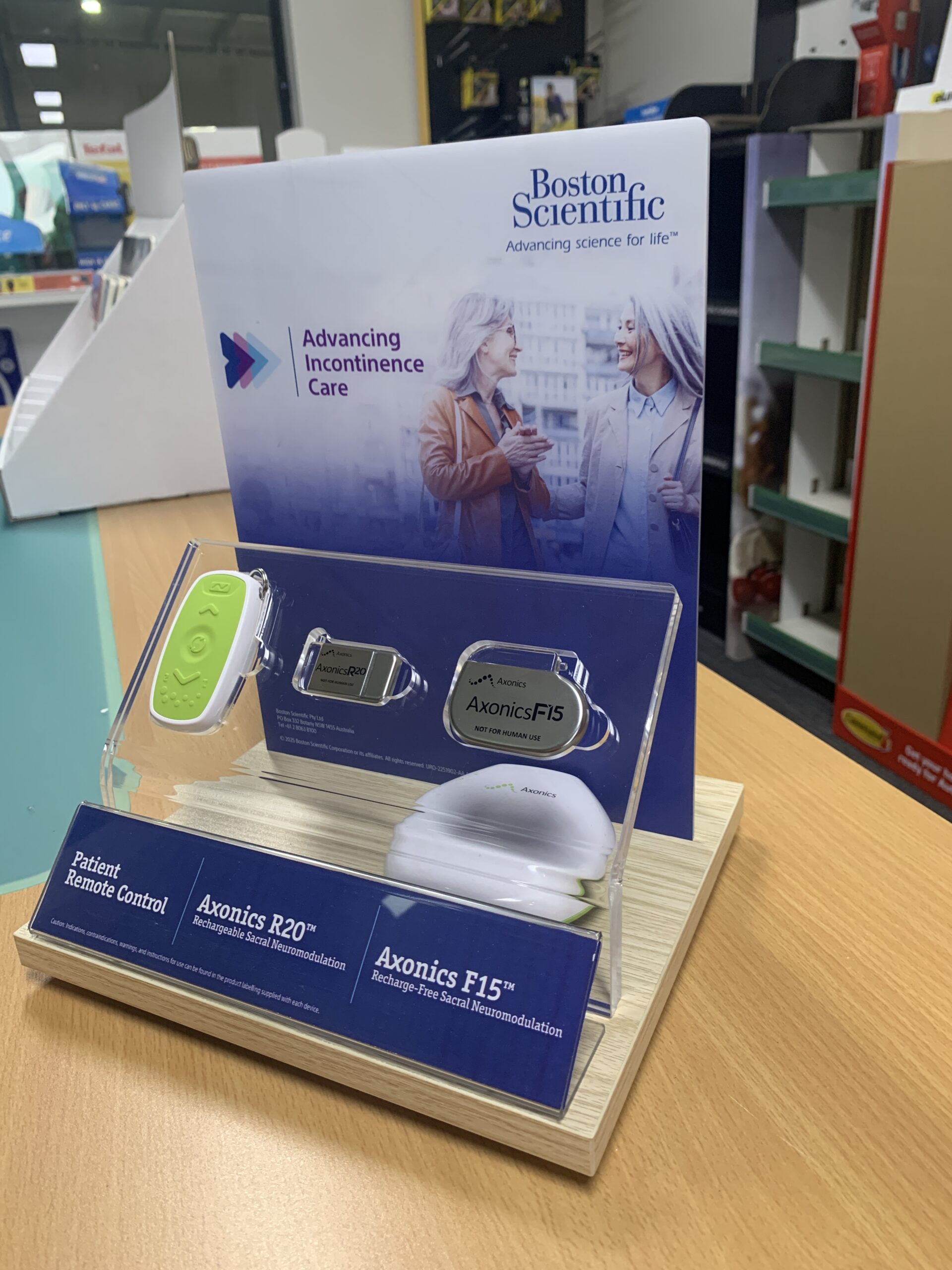
Counter top point of sale display for Boston Scientific & Axonics
Custom designed point of sale for medical sites
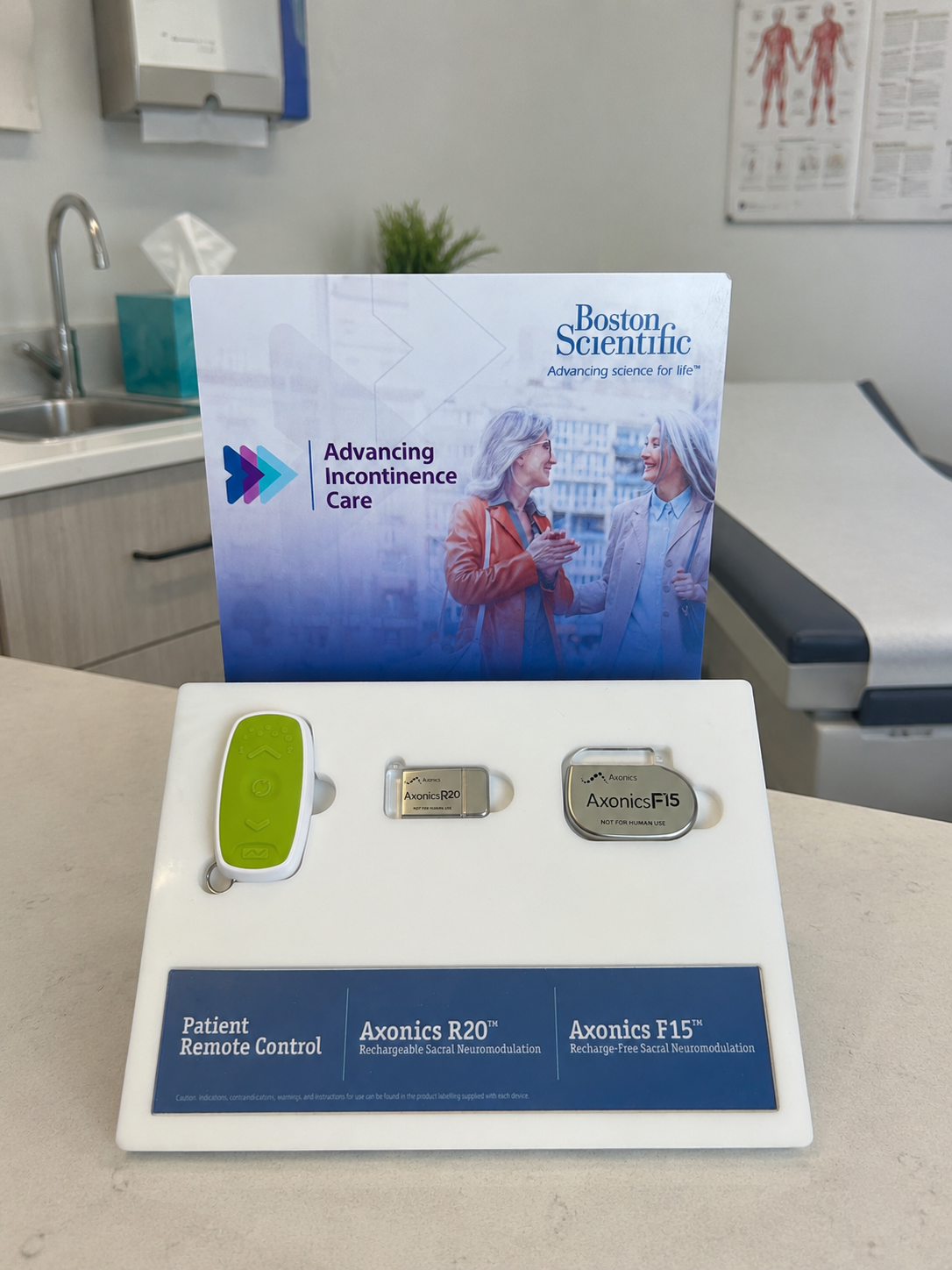
Genesis Retail Displays is a point of sale display design agency in Sydney that was engaged by Boston Scientific & Axonics.
When most brand managers think about point of sale displays, they picture the retail floor — supermarket gondolas, end caps in JB Hi-Fi, or pharmacy bays in Chemist Warehouse.
The Axonics brief was something altogether different, and it’s one of the more unique and rewarding projects we’ve undertaken at Genesis Retail Displays.
Axonics offers a long-lasting, clinically proven sacral neuromodulation therapy designed to help patients regain bladder and bowel control — conditions that significantly impact quality of life for millions of people. Their technology is implanted by surgeons and recommended by urologists and gynaecologists, which means the primary “point of sale” environment is a specialist consulting room, not a retail shelf.
The challenge was creating a display solution that could function effectively in that context while meeting the commercial and brand requirements of a global medical device company operating across Australia, New Zealand, the United Kingdom and Europe.
Boston Scientific, who distribute the Axonics product range across these markets, came to us with a brief that sat at the intersection of clinical credibility, brand consistency and practical functionality — a combination that demands a more considered design approach than a typical retail POS execution.
The point of sale for multi-market regulated product category
One of the first complexities any brand or product manager working in medical devices will understand is the variation in regulatory requirements, approved claims and messaging across different markets.
What can be stated on packaging or marketing material in Australia may require different language or substantiation in the UK or across European markets.
The display solution we developed was engineered from the outset with information flexibility built in. Rather than hard-coding messaging into the structural design, we created a system that allows market-specific content to be adapted without requiring a completely new display unit.
This is a significant commercial consideration — it protects the client’s investment across markets and reduces the unit cost by allowing a consistent base structure to be produced at scale, with localised content applied as needed.
This kind of modularity is something we build into projects where we know a brand is operating in multiple markets or anticipates evolving claims, regulatory updates or product additions over time. For medical device brands navigating multi-jurisdictional compliance, it’s not a nice-to-have — it’s essential.
How did the point of sale design meet the brief?
The Axonics therapy is a considered, long-term medical decision. It is not an impulse purchase, and the display needed to reflect the seriousness and quality of the product and brand.
This environment calls for a premium aesthetic, the kind of finish and material quality that signals confidence in the product and reinforces the clinical credibility of the recommendation being made. So we approached the design with a focus on refined material choices and precision in the way the devices are presented.
The display elevates the physical products so that surgeons, urologists and their clinical teams can interact with them naturally — picking them up, examining them, and using them as props when explaining the therapy to patients.
This kind of tactile accessibility is critical in a consultation setting. A patient who can physically engage with a device before a procedure is a patient who is better informed and more confident in their decision — and that directly supports conversion and patient outcomes.
The presentation also needed to communicate key messages clearly and hierarchy was important. Clinicians are time-poor; a display that requires effort to read or navigate will be ignored.
We structured the information to lead with the most critical claims and support them with the detail that patients and clinicians need to reach a decision.
Solving the compact footprint problem
Consulting rooms and specialist medical offices are typically small, often with limited desk, bench or shelf space already occupied by clinical equipment. A display that works in a 50-square-metre consulting room in Sydney needs to work equally well in a compact specialist practice in Edinburgh or Amsterdam.
Our design team approached this as a space-efficiency problem as much as a brand problem. The display needed to present the full product range and all key messages within a footprint that respects the clinical environment without dominating it. This required careful consideration of vertical versus horizontal space use, the hierarchy of product placement, and how the display would sit relative to a clinician and a seated patient during a consultation.
The result is a compact unit that punches well above its physical size in terms of presence and information delivery — something we see as a measure of good industrial design rather than a compromise.
An iterative process come up with prototype designs
The best point of sale solutions rarely arrive in the first concept.
The Axonics project involved several rounds of design development and physical prototyping in close collaboration with the Boston Scientific team.
This is a process we advocate strongly with all our clients, and especially those in technical or regulated categories where there are stakeholders beyond marketing involved in sign-off — including clinical, regulatory and commercial teams.
Prototyping allows everyone to stress-test ideas in the real world before committing to production. It surfaces problems — ergonomic, structural, logistical — that even the most detailed CAD rendering cannot fully reveal. For Boston Scientific, working through multiple iterations meant that by the time the final design was approved, every stakeholder had confidence in the solution and there were no surprises at production or rollout.
For brand managers and product managers leading display projects, this kind of collaborative, phased process also provides important internal alignment. By the time a display reaches the market, everyone from the sales team to regulatory affairs has had input, and adoption in the field is far smoother as a result.
More than just more marketing material
What we find genuinely compelling about this project is that the display functions as something more than a brand asset. In a retail context, a great display drives awareness, trial and purchase. In a clinical context, a great display facilitates understanding — it gives a clinician a better tool to explain a complex therapy, and it gives a patient a clearer picture of what their life could look like after treatment.
For the team at Boston Scientific and for us at Genesis Retail Displays, knowing that this display is sitting in consulting rooms across four markets — helping patients understand their options and make informed decisions about a therapy that could genuinely change their quality of life so it makes this one of the more meaningful projects in our portfolio.
If your brand operates in a clinical, healthcare or specialist retail environment and you’re looking for a display solution that balances brand integrity, market flexibility and genuine functional performance, we’d welcome the conversation.
Designing point of sale for medical sites
In Australia, any marketing material that relates to a therapeutic good — whether a medical device, pharmaceutical or treatment — falls under the jurisdiction of the Therapeutic Goods Administration (TGA).
The TGA has strict rules about what claims can be made, how they must be substantiated and who the material can be directed at. Consumer-facing advertising of prescription medicines and certain devices is either heavily restricted or outright prohibited.
This means that a display in a GP’s waiting room that a patient might read unsupervised is held to a completely different standard than one sitting on a clinician’s desk for professional use only. Getting this wrong exposes a brand to regulatory action and reputational damage.
Similarly in the UK, the MHRA and the ABPI Code of Practice govern how pharmaceutical and medical device companies can promote products to both healthcare professionals and patients. Across Europe, the EU Medical Device Regulation adds another layer. Any brand operating across multiple markets needs to design their display system — and their content — to accommodate these varying frameworks from the outset.
Professional and ethical guidelines
Beyond government regulation, professional medical associations impose their own codes of conduct around the relationship between commercial organisations and healthcare practitioners.
The Australian Medical Association, for example, has guidelines about the acceptance of gifts, hospitality and promotional materials from industry. Some practitioners or practices will have blanket policies about what commercial material they will and will not display — regardless of whether the TGA would permit it. A display that is perfectly compliant from a regulatory standpoint can still be refused at the practice level on ethical grounds.
This means sales and marketing teams need to invest time building genuine relationships with practice managers and clinicians rather than assuming a display can simply be placed and left.
Multiple gatekeepers
In retail, a brand negotiates with a category buyer or space planner and the display goes in. In a medical environment there is rarely a single decision-maker. A practice manager controls the physical space, the lead clinician controls what is clinically appropriate to present, a hospital procurement team may have jurisdiction over what enters the facility, and in some cases a broader ethics committee has oversight. Each of these stakeholders has different priorities — commercial, clinical, ethical and logistical — and the display solution needs to satisfy all of them.
This extends the timeline significantly and means the design brief must be developed with all of those audiences in mind, not just the end patient or clinician.
Infection control
Medical environments have strict hygiene standards. Any physical display or marketing material placed in a clinical setting — particularly anything that patients may touch — needs to be made from surfaces that can be wiped down with clinical-grade disinfectants without degrading. Porous materials, certain laminates, fabric elements or complex recesses that trap dust and bacteria are simply not appropriate. This rules out a significant proportion of the standard POS material palette and requires careful specification from the design stage.
For waiting rooms in particular, anything that multiple patients handle needs to withstand repeated cleaning. This has direct implications for structural materials, surface finishes and print methods.
Waiting room sensitivities
A patient sitting in a waiting room before a procedure or diagnosis is not in the same headspace as a shopper browsing a retail aisle. They may be anxious, distracted or emotionally vulnerable. Marketing material that feels overtly commercial or promotional in that environment can feel jarring and inappropriate — damaging the brand rather than supporting it. The tone, imagery and language of any consumer-facing material in a clinical waiting room needs to be calibrated carefully. Reassuring, informative and empathetic messaging performs far better than features-and-benefits retail copy.
Privacy is also a consideration.
In a waiting room where multiple patients with different conditions are present, a display about a specific health condition — bladder control, mental health, sexual health, for example — needs to be positioned and designed thoughtfully so that no individual patient feels identified or exposed by proximity to it.
Space and environmental constraints
Unlike a retail store where floor space is allocated commercially and display placement is negotiated as part of a ranging agreement, space in a medical environment is not for sale. Every square centimetre of a consulting room or waiting area is there for a clinical purpose.
A display that competes with that — physically or aesthetically — will be removed. Compact footprint, clean aesthetics and designs that feel like they belong in the environment rather than intruding on it are essential.
Do you have a product that you need help with to get more visibility, better demonstrability or increased sales?
Let’s make a display that sets you apart.