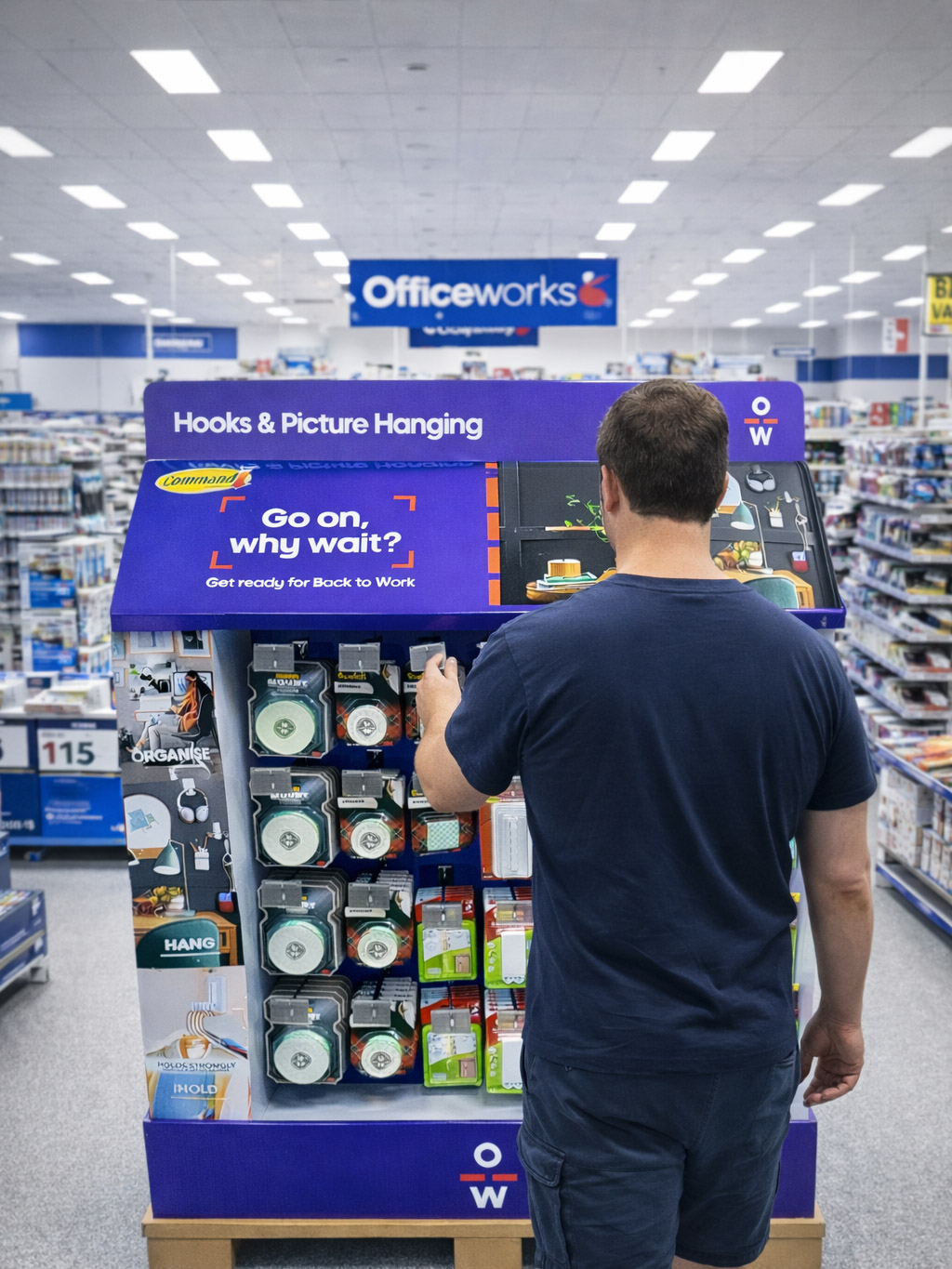
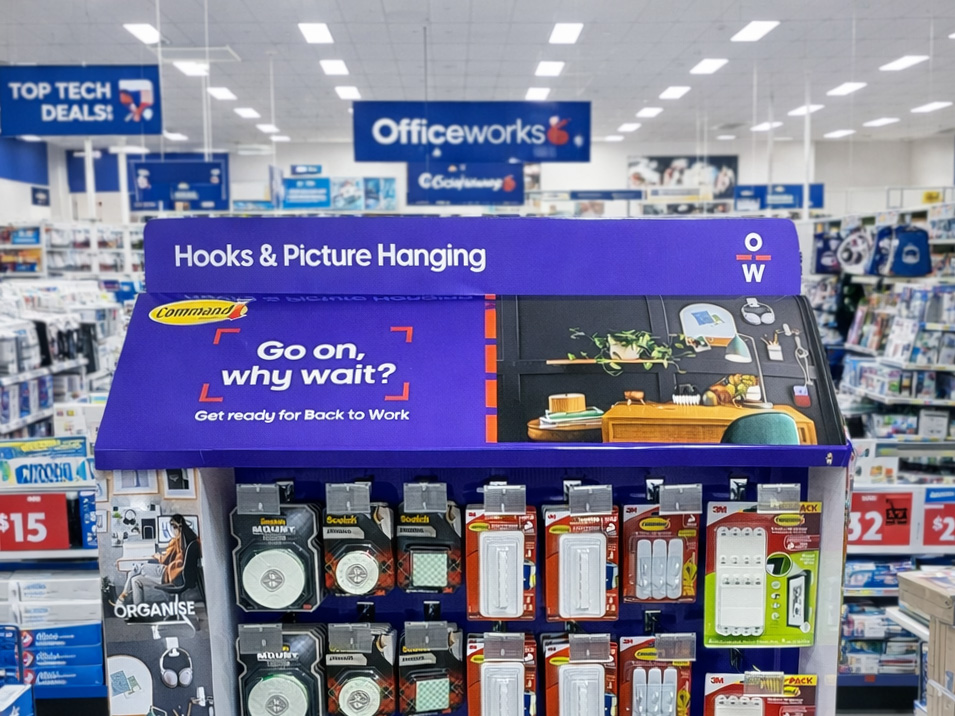
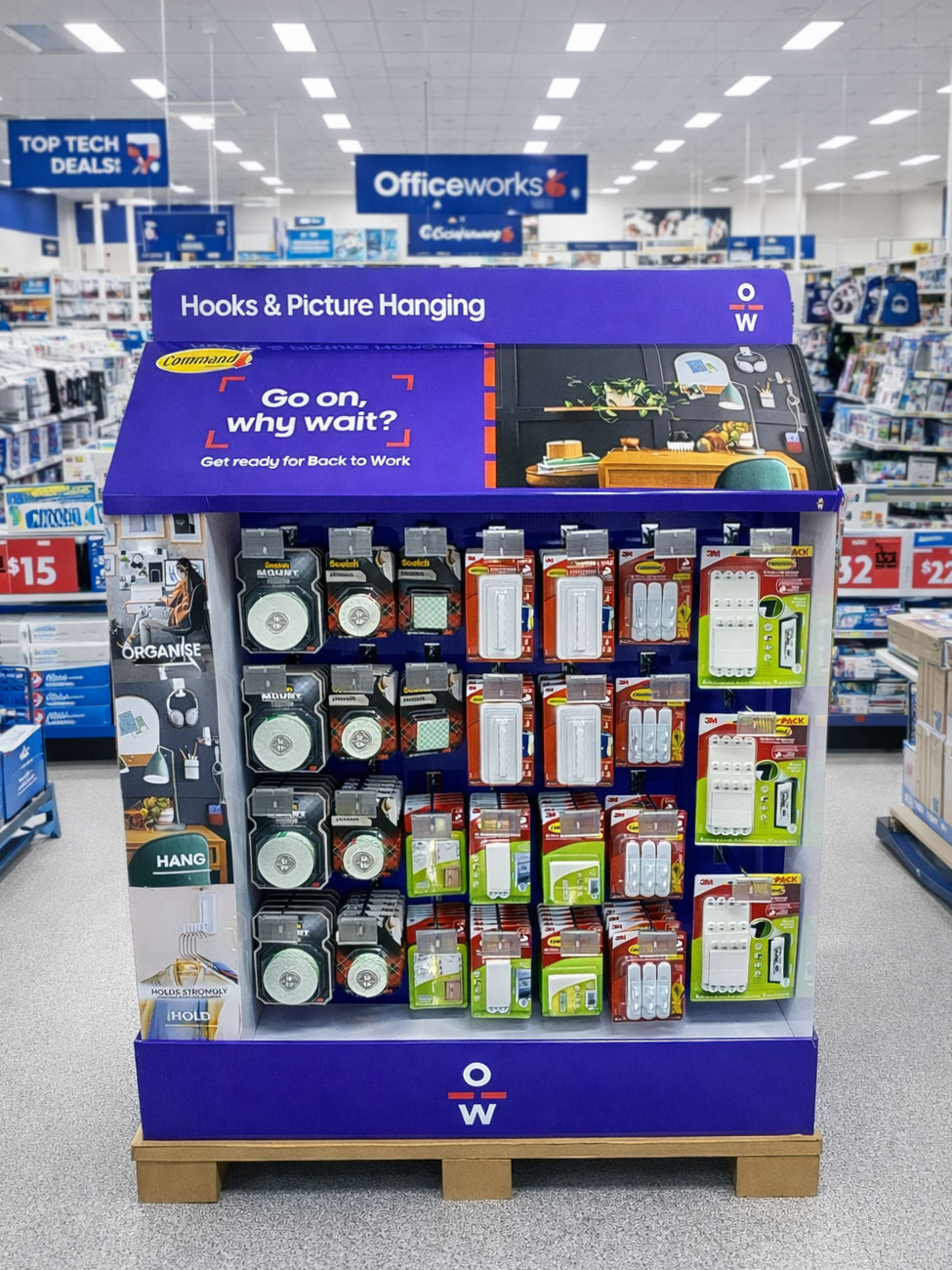
Pallet point of sale display for 3M in Officeworks
Custom designed point of sale for Officeworks retail stores
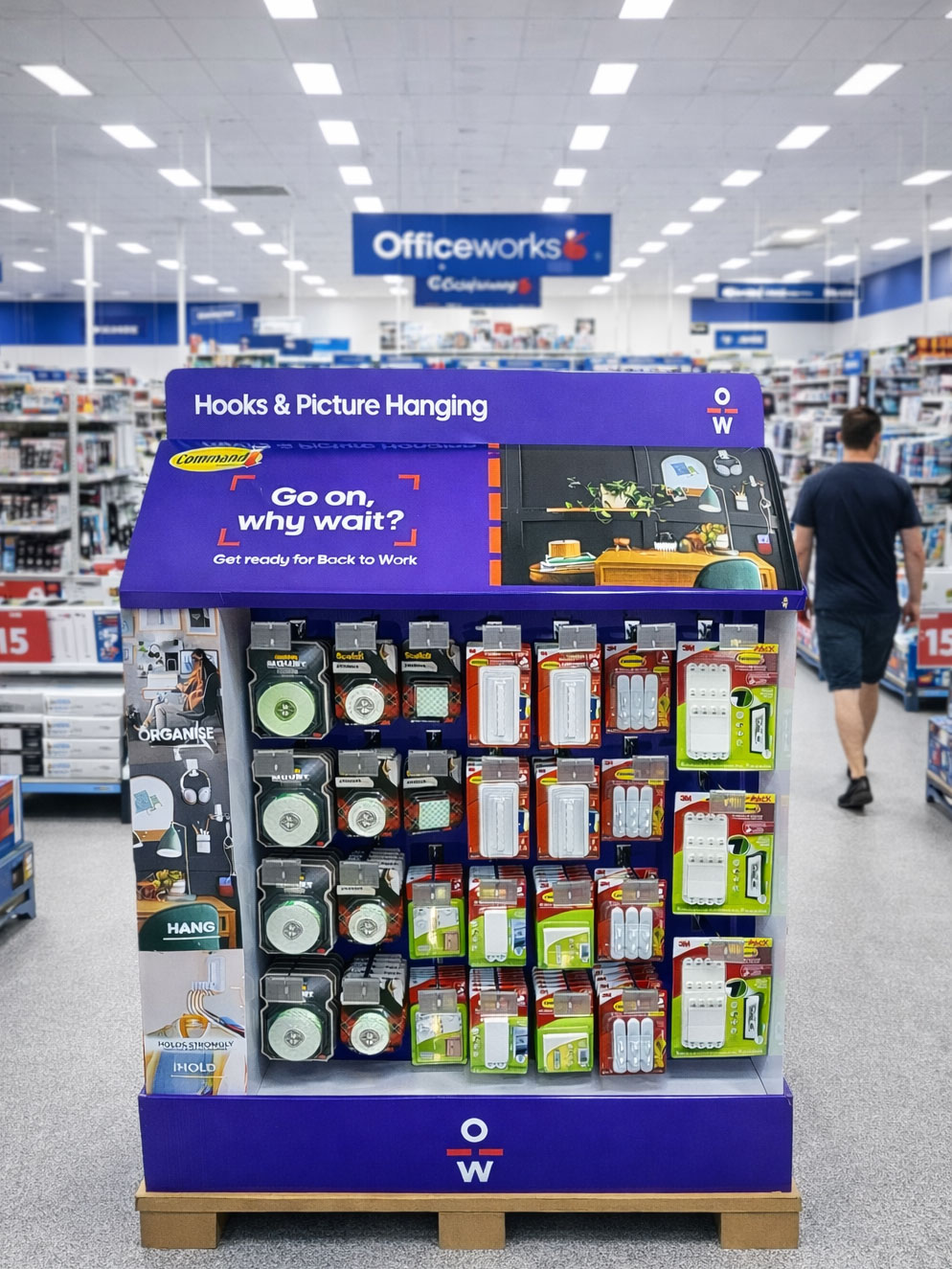
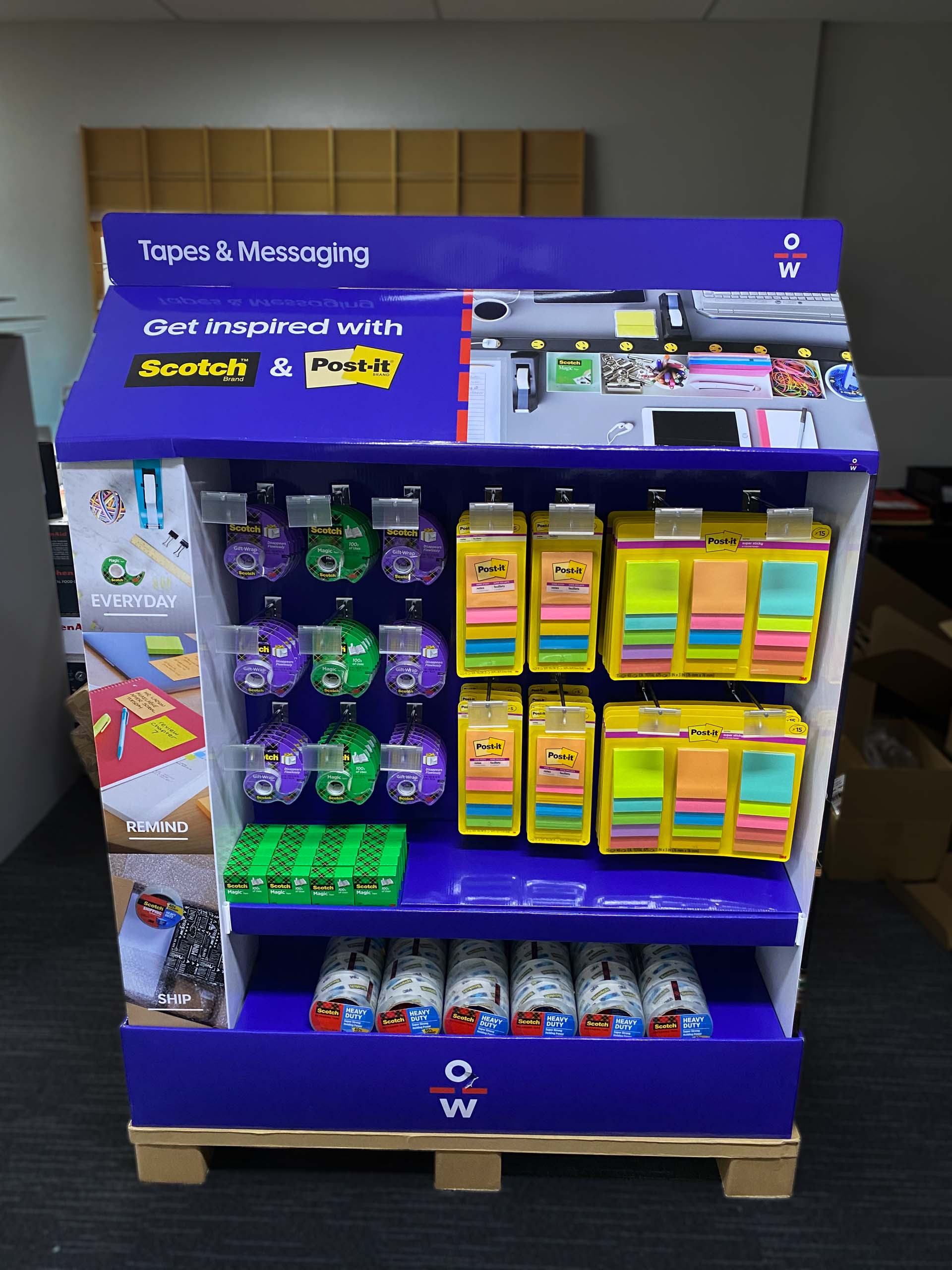
Genesis Retail Displays is a point of sale display design agency in Sydney that was engaged by 3M, one of the world’s most recognised innovation-led brands, to design and manufacture a high-impact half-pallet display unit for the annual Officeworks Back to Work campaign.
This campaign is one of the most competitive promotional periods in the Australian retail calendar, representing a critical moment for brands like 3M to capture shopper attention, drive trial, and defend market share on the shop floor.
The brief called for a display solution that could present multiple product categories clearly within a compact retail footprint, hold significant product loads throughout a high-traffic campaign period, and be deployed quickly and consistently across every Officeworks store nationally, all without placing excessive demands on in-store staff.
The 3M range of products sit in a sweet spot where the price is low enough to be impulsive but high enough that the display still needs to justify the purchase. A shopper won’t spend twenty seconds reading a shelf label on a $6 item, but a display that communicates the use case visually and instantly removes the decision friction entirely. The display does the justification work at a glance.
Critically, the solution Genesis designed performed so strongly in its first outing that 3M selected Genesis again for a repeat production run — a direct reflection of the display’s performance with shoppers, its operational reliability in-store and the confidence 3M placed in the Genesis team to deliver.
See it here
The point of sale display design concept
The thinking
The Back to Work season at Officeworks is intensely competitive. Dozens of brands compete for prime floor space and shopper attention during the same window, which means a display must do far more than simply hold product — it must actively work as a sales tool, communicating brand identity, guiding the shopper through multiple product categories, and encouraging both planned and impulse purchases.
In a staff-driven environments like JB Hi-Fi, a great display is an asset. In a self-serve environment like Officeworks, it’s closer to a necessity. Without a display working actively for the product, there’s no compensating mechanism.
The display is the salesperson which puts even more pressure on the design agency.
This is particularly relevant for a brand like 3M, whose products — Command hooks, Post-it notes, Scotch tape — are familiar to shoppers but rarely something they walk in specifically hunting for.
A bold, well-placed display intercepts the shopper mid-journey and creates purchase intent that didn’t exist when they walked through the door.
Working with traffic flows
Officeworks stores follow a fairly consistent warehouse-style grid layout with wide aisles and a logical category flow. Shoppers tend to move in predictable patterns, which means floor displays placed at key decision points with aisle ends the transition zones between departments or near the checkout are that can intercept a very high proportion of total store traffic.
A half-pallet at the right location in an Officeworks doesn’t just reach people browsing that category; it reaches almost everyone in the store.
Officeworks shoppers tend to buy multiple items in a single visit it’s a top-up and stock-up destination rather than a big-ticket single-item purchase store. That basket mentality is enormously valuable for a brand like 3M presenting three complementary product families together.
A shopper who came in for printer paper and notices the 3M display is highly likely to add a pack of Post-it notes or a roll of Scotch tape because those are low-consideration, low-risk additions to an already-forming basket. The threshold for a yes is very low.
So for 3M, this campaign needed to showcase three of its most beloved product families simultaneously:
- Command™ — hooks and picture-hanging solutions
- Scotch™ — a trusted range of adhesive tapes
- Post-it® — the iconic repositionable note range
Each of these product families carries its own distinct shopper audience and usage occasion. The challenge was to present them together in a way that felt coherent and intentional, rather than cluttered or confusing.
At the same time, the physical display needed to be strong enough to hold a full product load under real-world retail conditions, simple enough for store teams to set up without specialist tools or lengthy instructions, and compact enough to sit comfortably in the constrained floor space typical of Officeworks stores.
How did the point of sale design meet the brief?
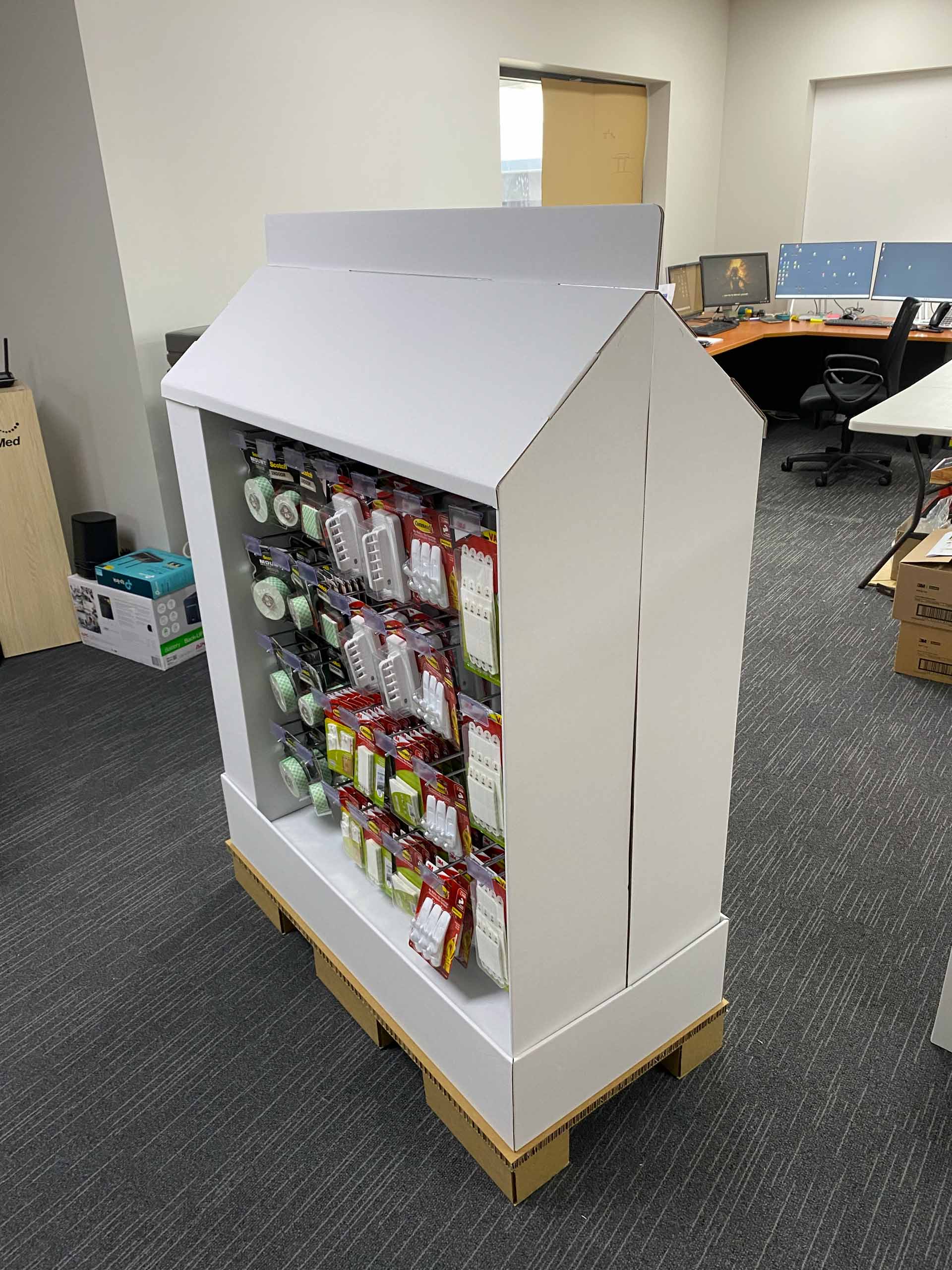
Genesis approached the brief with a dual-sided half-pallet structure which is a format that maximises usable display surface while keeping the overall footprint small.
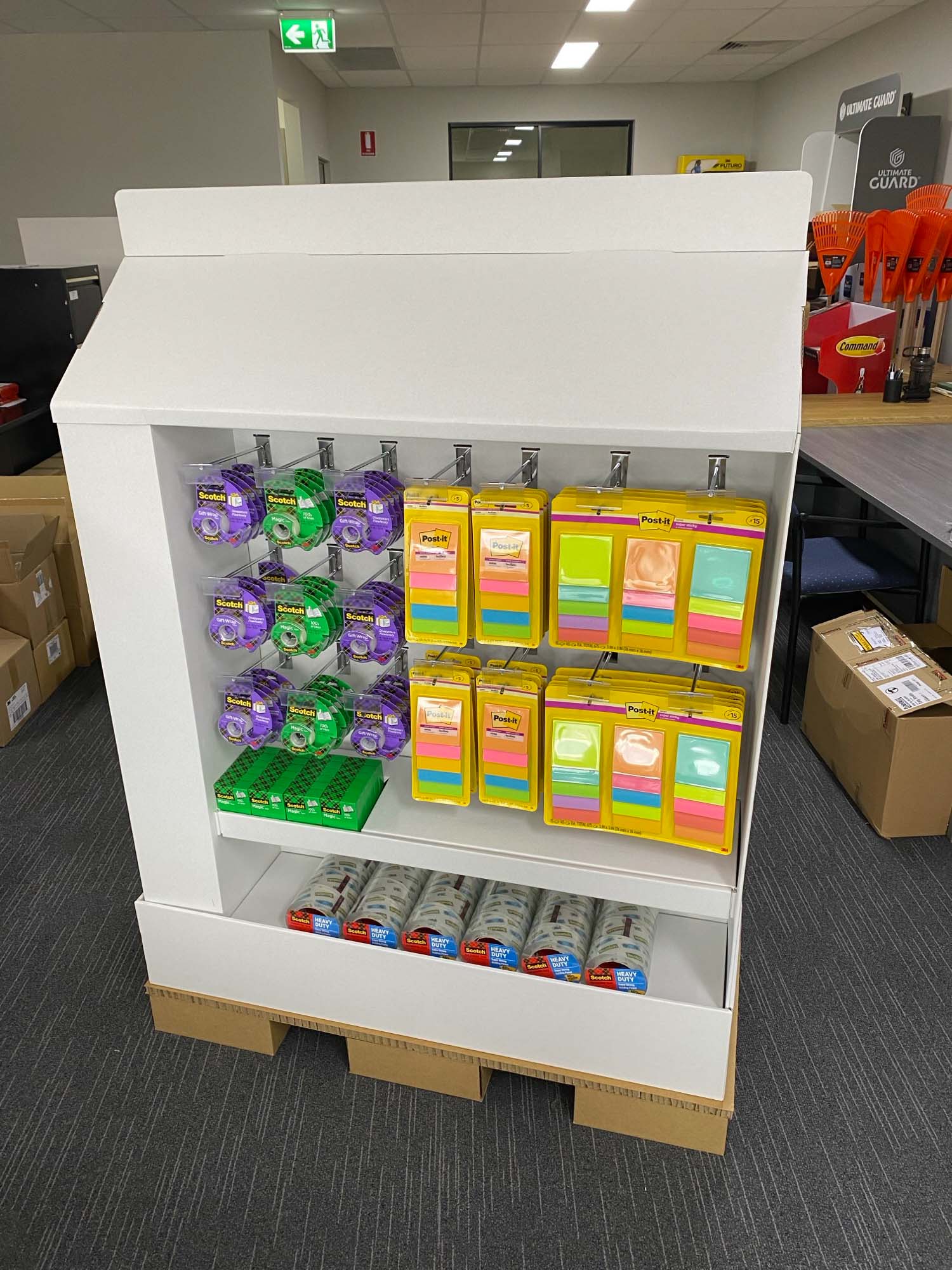
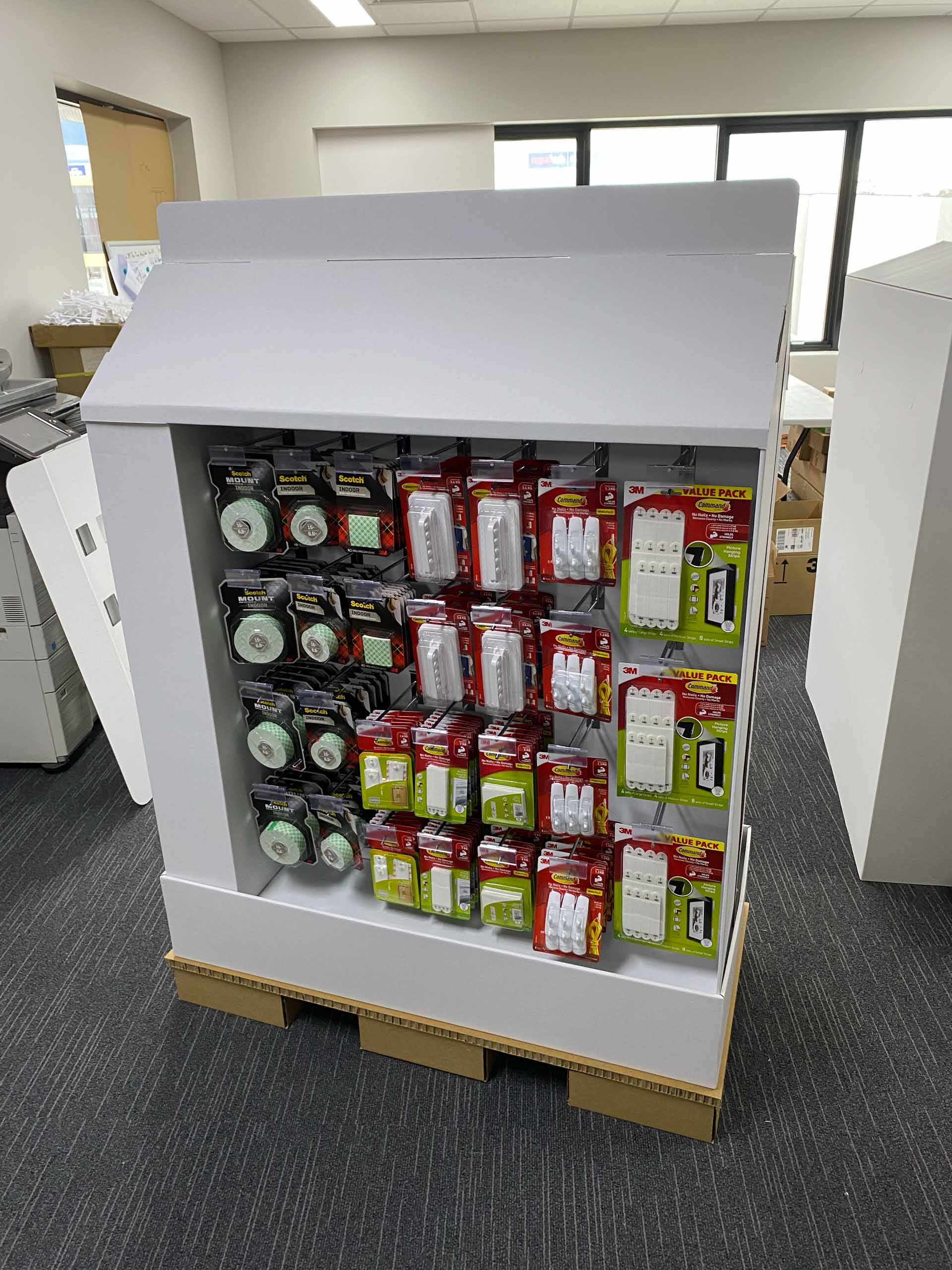
Rather than mixing all three product categories across one undifferentiated display face, the Genesis team made a deliberate structural and visual decision: to assign each side of the unit to a distinct product segment.
Side One — Hooks & Picture Hanging (Command™)
The first face of the display was dedicated entirely to Command™ hooks, adhesive strips and picture-hanging solutions. By owning a full side of the unit, the Command™ range could be presented with enough visual prominence to communicate its breadth of use cases — from kitchen organisation to artwork and photo hanging — without competing for attention against other product categories.
Side Two — Tapes & Messaging (Scotch™ and Post-it®)
The second face combined the complementary Scotch™ tape range with Post-it® notes — two product families that naturally sit together in a ‘desk essentials’ or ‘home office’ mindset. Grouping these products together creates an intuitive logic for the shopper: if you need tape, you probably need notes; if you’re stocking up your home office, both belong in your basket.
This category separation strategy is a key example of how Genesis brings genuine shopper marketing thinking to its structural designs. The architecture of the display is not just a physical decision — it is a commercial one, designed to increase the probability of cross-category purchase and to make the shopper experience feel easy and logical rather than overwhelming.
Design elements of the point of sale display
Reinforced Corrugated Board
The primary structure is manufactured from reinforced corrugated board — a material that offers an excellent balance of strength, weight and cost. Corrugated board is a well-proven medium in retail display, but not all corrugated construction is equal.
The reinforced specification used here gives the unit the structural integrity needed to hold a full product load across an extended campaign period, while keeping the unit light enough to be moved and positioned in-store without specialist equipment.
Metal Hooks
Product hanging is handled by metal hooks rather than cardboard-only shelf lips or plastic alternatives. Metal hooks are significantly more durable under repeated load and shopper interaction — they resist bending, maintain product presentation throughout the campaign, and hold packaged products securely, reducing the likelihood of products falling or shifting out of position. This is a detail that matters enormously over a multi-week campaign in a busy retail environment.
Metal Bar Shelf Supports
Load-bearing shelf areas are reinforced with metal bar supports — a critical structural choice that prevents the shelving from bowing or collapsing when carrying heavier stacked products. This is particularly important for a half-pallet format, which is designed to carry a larger product payload than a typical counter display or small floor unit. The metal reinforcement ensures the display maintains its structural integrity and visual appearance from the first day of the campaign to the last.
High-Quality Printed Graphics
Structural engineering and print quality work together to create the final shopper impression. The display features high-quality printed graphics across its key brand and product communication panels.
Bold, accurate colour reproduction is essential when displaying globally recognised brands like 3M, Command™, Scotch™ and Post-it® — each of which carries strict brand guidelines and high consumer recognition.
Strong graphics also work as a signalling device in-store, drawing shopper attention from further afield and communicating the category to shoppers before they have read a single word.
Distribution and set up of point of sale displays
Even the most beautifully designed display can become a liability if it is complex to set up, inconsistently executed, or places excessive demands on store personnel. Genesis addressed this challenge directly through a pre-packed display solution that eliminates the most common points of failure in retail display execution.
Pre-Packed at Distribution
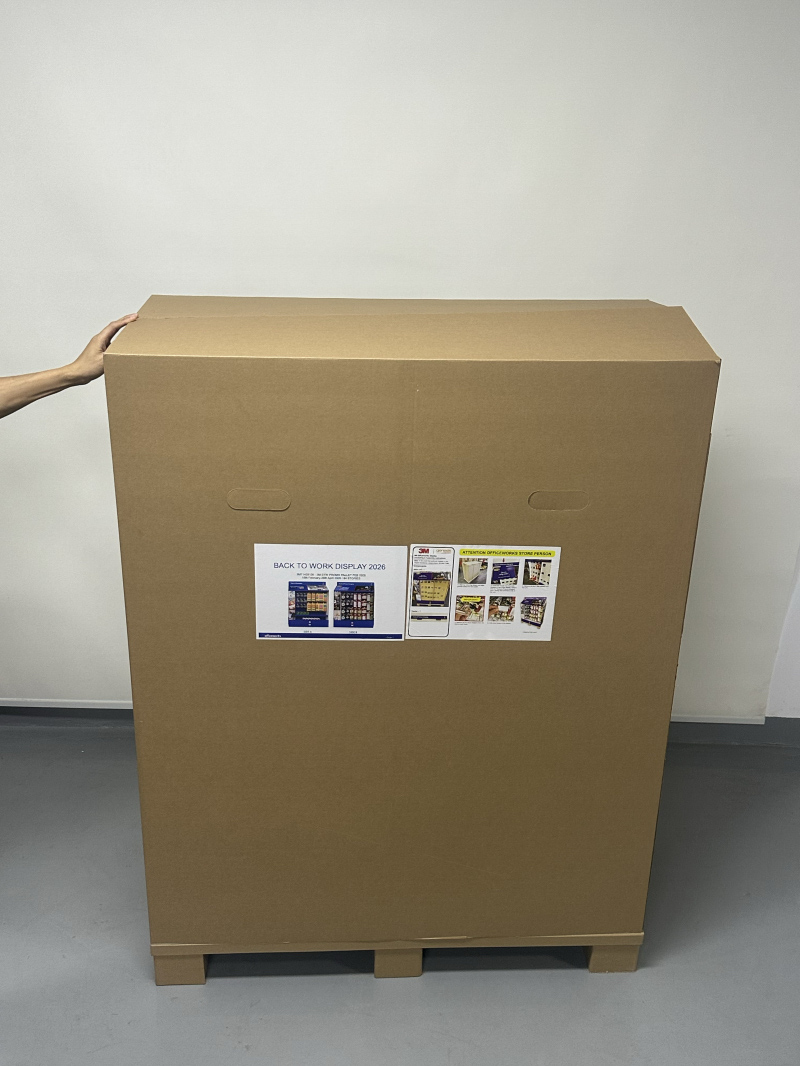
Rather than shipping empty display units and product separately — and relying on store teams to merchandise them correctly — Genesis designed the program so that displays were pre-packed with product at the distribution stage. When the display arrives in-store, it is already loaded and ready to go. This approach has several significant commercial advantages:
• Consistency: Every store receives an identically merchandised display, ensuring brand presentation is uniform across the entire national network.
• Speed: Store team set-up time is reduced to a matter of minutes rather than the hour or more that manual merchandising can take.
• Accuracy: Products are in the correct positions and quantities as intended by the brand — removing the risk of human error in-store.
• Labour efficiency: Store staff do not need to dedicate time to learning a planogram or sourcing product from the back room.
Three-Step Installation Process
Once the display arrives in store, the setup process is deliberately simple:
1. Remove the outer shipper carton
2. Remove internal transit fillers and protective packaging
3. Position the display on the shop floor — it is immediately ready for shoppers
This three-step process is the result of careful structural planning during the design phase. The outer shipper doubles as transit protection, meaning the display travels safely to store without requiring additional protective packaging that would need to be removed and disposed of. The internal transit fillers protect product and structural elements during freight, and are quick to remove once in-store.
The simplicity of this process is not accidental, it reflects Genesis’s deep understanding of the operational pressures facing retail store teams.
In a busy Officeworks store during Back to Work season, staff are under significant time pressure. A display that requires minimal handling is not just a convenience; it is a competitive advantage for the brand that chose to invest in getting the logistics right.
A repeat engagement = proof of prior performance
The strongest validation of any retail display program is not an award or a render, it is the decision by a client to do it again.
Following the success of the initial Back to Work campaign, 3M selected Genesis Retail Displays to produce the display program for a second time.
This repeat engagement reflects several important realities:
• The display performed commercially in-store — driving shopper engagement and sales uplift across 3M’s Command™, Scotch™ and Post-it® product families.
• The display was operationally reliable — it held up structurally throughout the campaign period, maintaining visual quality and product presentation from launch through to the final week.
• The execution was consistently delivered across all stores — the pre-packed, three-step setup process meant that the standard of display presentation was maintained nationally, without exceptions or variations.
• The partnership worked — 3M’s brand managers and marketing team trusted Genesis to manage the brief, the design, the production, the logistics and the delivery without surprises.
In an industry where brands have many choices of display partner, repeat business is the clearest possible signal of genuine performance. It means the display did not just look good in a presentation, it delivered in the real world, under real conditions, with real shoppers.
Why Genesis Retail Displays
This program demonstrates several of the capabilities that define Genesis Retail Displays as a point of sale partner for global brands:
Shopper-First Design Thinking
The dual-sided category architecture was not simply a structural decision — it was a shopper marketing decision. Genesis thinks about how shoppers navigate, discover and decide, and builds those insights directly into the physical structure of every display it designs.
End-to-End Project Management
Genesis managed every stage of this program: brief, concept, design, prototyping, production, pre-packing and national distribution. For 3M’s brand team, this meant one point of accountability and one set of project communications — not a fragmented supply chain involving multiple vendors.
Structural Engineering Expertise
The combination of reinforced corrugated board, metal hooks and metal bar shelf supports reflects genuine structural engineering expertise. Genesis does not design for the render — it designs for the shop floor, where displays must perform reliably under real retail conditions.
Logistics Intelligence
The pre-packed, three-step installation process was a logistics solution as much as a structural one. Genesis’s ability to design displays that are efficient to fill, safe to freight, and simple to deploy is a significant operational advantage for brands managing national retail programs.
A Track Record That Speaks for Itself
Genesis Retail Displays has been designing and delivering point of sale programs for global brands in Australia for more than 15 years. It is an award-winning agency — recognised with Gold, Silver and Bronze at the SHOP! ANZ Retail Marketing Awards — and a team of industrial designers, marketers and project managers who are genuinely passionate about in-store retail.
Do you have a product that you need help with to get more visibility, better demonstrability or increased sales?
Let’s make a display that sets you apart.