How to execute a free standing cardboard pos display program in Coles in the most efficient way
Designed POS displays for placement in Australian Coles supermarkets
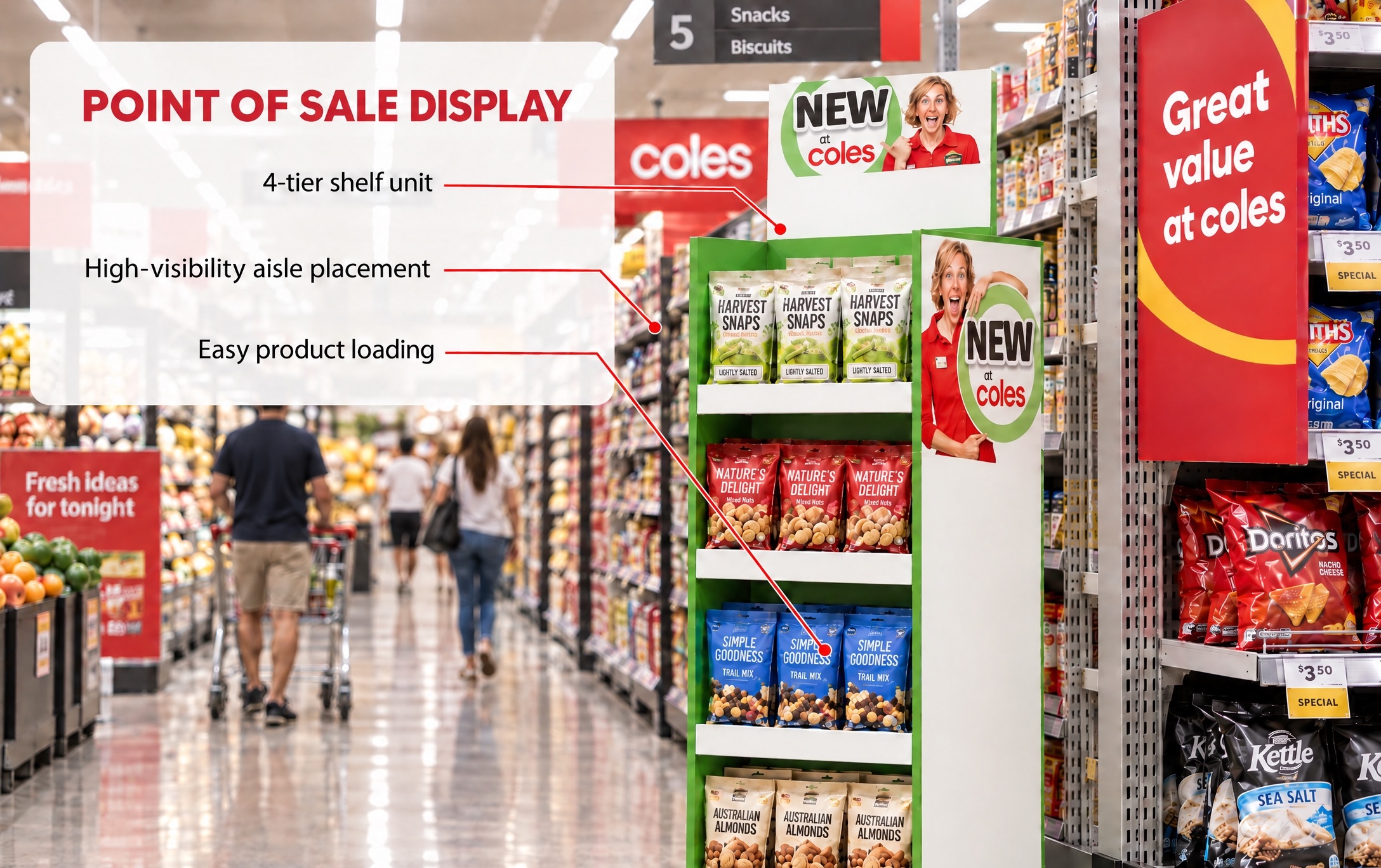
A free-standing display unit (FSDU) earns approval in Coles when;
- It fits the standard 1650mm x 445mm x 430mm footprint
- Carries a recognised Coles value offer
- Reaches the Category Manager at least six months before it is due in store.
Proposals that meet those three conditions move through approval quickly. If you miss any one of them are delayed, sent back for redesign, or declined.
Off-location displays, often called “not on shelf” displays, sit away from the home bay in high-traffic positions such as aisle ends, entrances and checkout approaches. For a brand launching a new line, or a brand that cannot win more facings on a crowded shelf, an off-location program is one of the few ways to add selling space in Coles without displacing an existing range.
Coles standardised its off-location format so that stores can plan floor space around a known unit size, and so that suppliers can choose from pre-approved designs. This article explains how that standard works in practice, drawing on the Coles Off-Location Display Style Guide or request this from the buying team) and on our experience designing and manufacturing displays for Australian retailers. It is written for product managers, trade marketing managers, retail marketing managers and anyone responsible for planning in-store executions.
Start six to twelve months out
Coles requires suppliers to submit a proposed off-location plan to the Category Manager a minimum of six months in advance. A twelve-month plan is preferred, because off-location positions are allocated against a store-by-store master plan and the best positions are committed early.
The approval path runs in a fixed sequence. Each stage depends on the one before it, so a delay early in the process compresses everything that follows.
- Submit the off-location plan to the Coles Category Manager, at least six months before the in-store date.
- Coles confirms the off-location and its dates, aligned to the Off-Location Master Plan.
- Nominate the display unit from the approved options in the style guide.
- Physical sign-off by the Category Manager and Store Operations that the selected unit is fit for purpose for the proposed product range.
- Artwork approval by Coles Category Marketing.
- Photography-ready unit delivered six weeks before landing in stores. Coles photographs it as the “what a good job looks like” reference for the store communication pack.
- Display lands in store for a minimum run of two weeks, in line with the master plan dates.
The six-week photography deadline is the one most often underestimated.
It means the final, production-standard unit must exist well before the production run is delivered to the distribution centre. In our experience, the time needed to design, prototype, approve and manufacture a cardboard FSDU means the design brief should be issued no later than 14 Weeks prior to promotion.
Before any buy plan is committed, Coles also expects the supplier to have engaged its replenishment manager, Category Marketing, Store Operations and DC/Logistics teams.
Production lead times
Once Coles has confirmed the off-location, the display itself must be designed, approved, prototyped, printed and delivered. Working backwards from the photography deadline gives the latest point at which each stage can start.
| Stage | Typical duration | Latest start (weeks before in-store date) |
|---|---|---|
| Design brief, quote and 3D visual | 1 week | 14 to 16 weeks |
| Coles artwork approval | Allow 2 weeks | |
| Prototype build, stock-fit testing and photography-ready unit | 2 weeks | |
| Production print and manufacture and delivery | 9 weeks | |
| Prepacking by a 3PL (if required) | 3 to 4 weeks | |
| Distribution | Allow 3 weeks |
If re-running a previous design, place the order by 10 weeks ahead of required delivery to warehouse date.
Plan around the Coles seasonal calendar
The six-month minimum means seasonal programs are planned in a different season from the one they serve. The dates below apply the six-month rule to common retail events. They are the latest point for the off-location plan to reach Coles, not the ideal one.
| Event | Typical in-store window | Latest plan to Coles (6 months prior) | Recommended brief to your display designer |
|---|---|---|---|
| Back to school | January | July | September |
| Easter | March or April (date moves each year) | September or October | November |
| Winter, cold and flu | June to August | December | February |
| Father's Day | August to early September | February | April |
| Christmas | November to December | May | June |
Design to the standard footprint
The standard Coles off-location unit is the Easy Erect 4 Shelf, with a maximum overall size of 1650mm high, 445mm wide and 430mm deep. Grocery chains value operational consistency, and Coles stores have mapped every off-location position on the assumption that units arrive at this size.
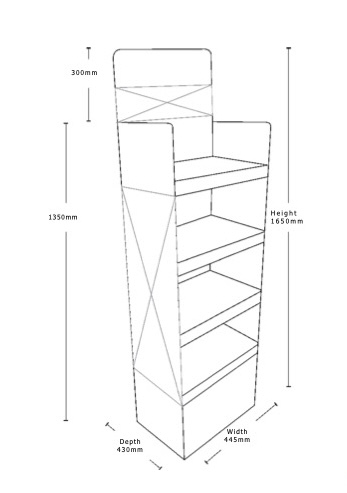
| Element | Specification |
|---|---|
| Overall height | 1650mm (including header) |
| Overall width | 445mm |
| Overall depth | 430mm |
| Header artwork | 150mm x 445mm (approximate) |
| Side panel artwork | 720mm x 430mm (approximate) |
| Shelves | 4 |
| Load per shelf | Up to 16kg |
| Products per shelf | No more than one line |
The shape and design of the unit can differ from the Coles example, provided the total overall measurements are respected. This gives a brand room to create a distinctive structure while staying inside the approved envelope.
A unit larger than the standard requires sign-off from the Head of Operations Merchandise Support team, arranged through the supplier’s Operations Support Manager. That extra layer of approval adds time and carries a real risk of rejection. Where a product genuinely does not fit the standard dimensions, raise it with Coles at the plan stage rather than after the design is complete.
We always submit a three-dimensional visual of the proposed unit with the plan. A rendered visual lets the Category Manager and Operations assess stock fit, branding and floor presence before any cardboard is cut.
Lead with a Coles value offer
Every off-location display in Coles must carry a value offer. A display that simply presents a brand, without a reason for the shopper to buy now, will not be approved. The guide recognises four types of value offer:
- Promotions. Every SKU on the display must have a saving for the full off-location period.
- New line introductory offers. For products new to Coles.
- Marketing campaign support. Tied to a Coles campaign with a value offer, such as a Down Down launch.
- Events. Non-standard events must have a clear exit date, agreed with Store Operations, and be cleared before the next month’s off-locations begin.
The value offer is communicated through Coles promotional creative, not the supplier’s own branding. Coles brand assets are what shoppers recognise in store, and the style guide provides set templates for each mechanic. The supplier’s artwork occupies the defined panels around the Coles creative.
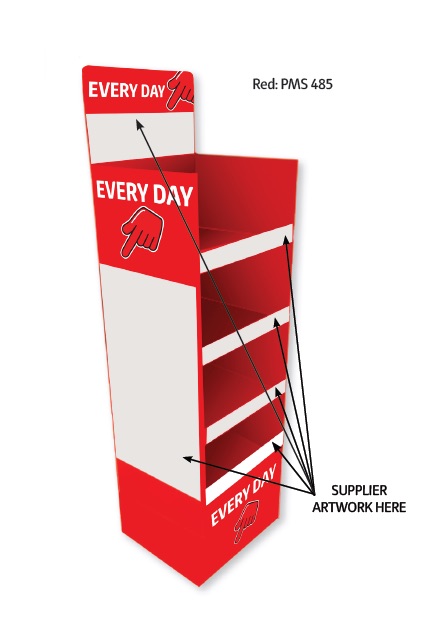
- Everyday creative, Red PMS 485.
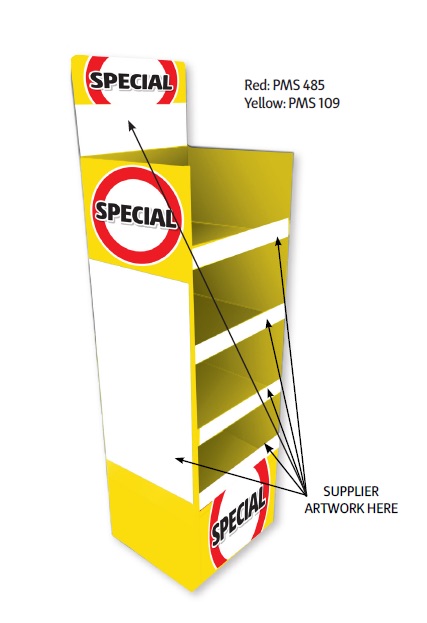
- Special creative, Red PMS 485 and Yellow PMS 109.
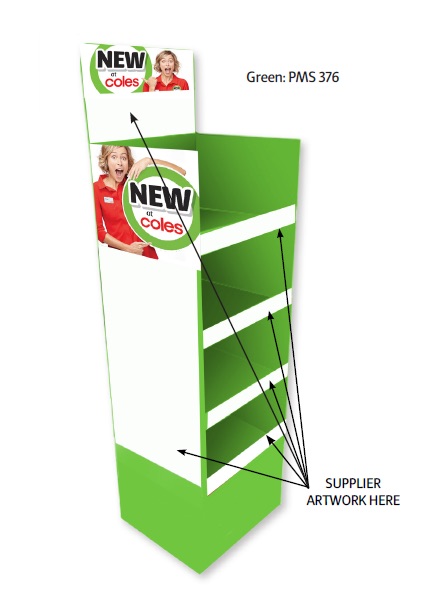
- NEW creative, Green PMS 376.
Two rules govern how the creative is used.
- Coles branding must not be obscured by product.
- Every product on the unit must match the primary call-out. A display themed NEW may only carry lines that are genuinely new at Coles. Where that is not possible, the supplier may design its own creative, but only by exception and after discussion with Coles.
The three concepts below show how we apply the Everyday, Special and NEW templates to the Easy Erect 4 Shelf. In each, the Coles creative holds the header, the upper side panel and the base, while the supplier’s artwork sits on the header strip, the lower side panel and the shelf edges.
Engineer the unit for the store floor
A display that is approved on paper can still fail in store if it is slow to build, unstable when loaded or damaged by daily cleaning. Coles store teams assemble these units between other tasks, so simplicity is a design requirement, not a preference.
- Fast, intuitive assembly. The unit should be very simple and fast to erect. Include clear, illustrated assembly instructions inside the display carton so the store team does not need to search for them. Suppliers may also assist with set-up in store to ensure the unit is compliant. Assembly time should be less than 5 minutes, the Genesis Presto display assembles itself in 5 seconds with 2 steps.
- Prototype before production. A physical prototype must be manufactured and tested for stock fit and weight before the production run is approved. The prototype confirms that each shelf holds its intended facings, that the unit stays square and stable when fully loaded, and that every shelf carries up to its rated 16kg without bowing. It is also the unit Coles Category and Operations teams physically sign off as fit for purpose.
- Data strips on every shelf. Each shelf needs a data strip to hold the shelf edge label, a minimum of 105mm long and 39mm high, fixed to the left-hand side of the shelf. Where more than one SKU appears on a shelf, the data strip must run across the entire shelf front. Note that the guide also states no more than one line should be displayed per shelf, so confirm the intended shelf layout with the Category Manager early.
- Protection at the base. Coles floors are mopped daily. Units must be supplied with either a plastic base or a water-resistant clear coating to protect the structural integrity of the board.
- One line per shelf, branding visible. Plan the planogram so that product sits below sightlines to the Coles creative, and so that each shelf carries a single line.
Choose materials with the whole life of the unit in mind
A Coles off-location runs for a minimum of two weeks and is cleared before the next month’s program begins. That short life is why corrugated board is the default material: it is light enough to meet the 16kg handling limit, prints well, and can be recycled once the display is removed.
| Material | Typical use in grocery | Strengths | Limitations |
|---|---|---|---|
| Corrugated cardboard | Standard Easy Erect FSDU, two to six week programs | Light, low cost at volume, recyclable | Vulnerable to moisture without base protection |
| Reboard or honeycomb board | Premium launches needing a sharper finish | Rigid, smooth print surface, paper based | Higher cost {Andrew confirm} |
| Plastic or metal components | Bases, clips, longer-running units | Durable, moisture resistant | Heavier, harder to recycle, higher cost |
Base protection involves a trade-off. A plastic base gives the strongest protection against daily mopping but adds a second material to separate at disposal. A water-resistant clear coating keeps the unit in one material stream, provided the coating does not prevent recycling.
We typically suggest using a polypropylene base and recommend aqueous varnish print coating as it is recyclable.
Plan the end of the program as carefully as the start. Confirm who removes the unit, whether stock is returned or sold through, and that the board can enter the store’s cardboard recycling stream.
Why off-location proposals are rejected
Most rejected or delayed proposals fail on a small number of avoidable issues. Each one below traces back to a requirement in the Coles standard.
| Reason | What happens | How to avoid it |
|---|---|---|
| Submitted too late | Positions are already allocated in the master plan | Submit at least six months ahead, ideally twelve |
| Oversized unit | Extra approval layer, frequent redesign | Design inside 1650mm x 445mm x 430mm from the first concept |
| No value offer | Display is declined outright | Attach a promotion, new line, campaign or event to every program |
| Products do not match the call-out | Creative must be changed, or the range reduced | Only place genuinely new lines on a NEW unit, and so on |
| Coles branding obscured | Artwork or planogram sent back | Check sightlines with stock loaded on the prototype |
| Overweight or poorly packed units | Refused at the DC | Test packed weight on the prototype, one unit per labelled outer |
| Unit unstable or slow to assemble | Poor compliance in store | Prototype, load-test and include assembly instructions |
| Cross-functional teams not engaged | Buy plan stalls | Engage replenishment, Category Marketing, Store Operations and DC/Logistics early |
Budget for the full program cost
The supplier funds the display. Coles sets the cost price of the cardboard unit at one cent in its systems, so the display carries no meaningful cost to the retailer.
The full investment in design, prototyping, printing, manufacture, packing and freight sits with the brand, and should be weighed against the incremental sales the off-location is expected to generate.
The main cost drivers for a Coles FSDU are:
- Quantity. Unit cost falls sharply as the run grows, because print set-up and cutting form costs are spread across more units.
- Print method and colours. Matching three Coles Pantone colours alongside brand artwork affects the print process selected.
- Supply format. Pre-packed units add labour for packing stock into each display.
- Base protection. A plastic base costs more than a water-resistant coating.
- Freight and storage. Determined by pallet configuration and the number of DCs served.
Measure whether the program paid for itself
An off-location is justified by incremental sales, the units sold because the display was there, not total sales during the period. Agree how you will measure it before the program starts, so the result can support the next proposal to your Category Manager.
- Set a baseline. Record average weekly unit sales for the featured SKUs over the weeks before the program, excluding other promotional periods.
- Measure the program period. Record weekly unit sales for every week the display is in store.
- Separate the price effect. Where the display carries a price promotion, compare against a previous promotion at the same price without an off-location, so the display’s contribution is not overstated.
- Check stores with and without the display. If not every store receives a unit, compare sales growth between the two groups over the same weeks.
- Calculate the return. Divide the total program cost (display, freight and any promotional funding) by the incremental units to give a cost per incremental unit, and compare it with the margin each unit earns.
A successful result, shown in the Category Manager’s own sales data, is the strongest argument for securing the next off-location.
How Coles differs from Woolworths
Many brands run off-location programs in both major supermarket chains. Both set rules on unit size, weight and branding, but the specifications are not interchangeable, and a unit designed for one chain will not automatically be approved by the other.
| Requirement | Coles | Woolworths |
|---|---|---|
| Standard unit size | 1650mm H x 445mm W x 430mm D | 1300mm H x 700mm W x 500mm D |
| Maximum unit weight | 16kg (pre-pack and flat pack) | |
| Retailer promotional creative | Coles templates such as Special, NEW, Everyday | Brand to confirm with WW |
| Minimum planning lead time | 6 months, ideally 12 | 12 weeks out |
| Base protection | Brand to confirm with retailer | Brand to confirm with retailer |
Where a program will run in both chains, design the structure to the stricter dimension of each and plan separate artwork for each retailer’s creative.
For Woolworths programs, request POS display Guidelines from Woolworths buying team.
Work with a Coles-experienced display designer
Genesis Retail Displays designs and manufactures free-standing displays that are built to the Coles standard from the first sketch. We prepare the three-dimensional visual for your Category Manager, build and test the prototype, and manage production through to delivery at the DC.
Frequently asked questions
- What is the maximum size of an FSDU in Coles? The standard off-location unit is 1650mm high, 445mm wide and 430mm deep. Larger units need sign-off from the Head of Operations Merchandise Support team.
- How far in advance should I submit an off-location proposal to Coles? A minimum of six months before the in-store date. Coles recommends a twelve-month plan.
- Can I use my own brand creative on a Coles off-location display? Only by exception. Coles promotional creative such as Special, NEW or Everyday is the default, and supplier-designed creative must be discussed with Coles first.
- How long does an off-location display stay in store? A minimum of two weeks, in line with the Off-Location Master Plan dates agreed with Store Operations.
- What is the weight limit for a Coles display unit? Each shelf may carry up to 16kg, and a pre-pack or flat pack unit must weigh no more than 16kg in total so it can be picked by hand.
- When should I brief a display designer for a Coles Christmas program? The off-location plan should reach Coles by May at the latest for a November to December program. Brief your display designer before then so a 3D visual can accompany the plan.
- Can the same display be used in Coles and Woolworths? Not automatically. The two chains have different specifications and promotional creative, so a shared structure usually needs separate artwork and may need resizing.
- Are cardboard off-location displays recyclable? Corrugated board units can generally be recycled once removed. Plastic bases and some coatings must be separated first, so the base option should be chosen with disposal in mind.